…you should work with humans.
This seems pretty straightforward, right?
Then why is it we’re all SO obsessed right now with turning over our very human-centric wellness businesses — like massage therapy, psychotherapy, somatic experiencing, acupuncture, coaching, and holistic health work — over to… robots?
It seems everywhere we look these days, Artificial Intelligence is the answer.
I’m part of a very active online group for massage therapists, and almost every time someone posts a question about a client issue, communication problem, or website conundrum, half the replies seem to say the same thing:
“Just ask AI.”
And it begs the question:
If you’re in the human business, shouldn’t you rely on humans?
Shouldn’t we be trusting our most basic form of human connection— that is, communication— to Actual Intelligence? Emotional Intelligence? Lived Intelligence?
Because the truth is…
Your website is not just a piece of technology.
Your website is a relationship.
For many potential clients, your website is the very first interaction they have with you before they ever step into your office, schedule a consultation, or send an email.
It’s where someone lands when they’re feeling overwhelmed, curious, burned out, in pain, or quietly wondering if they’re ready to ask for help.
They’re not just asking:
What services does this person offer?
They’re asking something much deeper:
Do I feel safe here?
Does this practitioner understand what I’m going through?
Could this be the right support for me?
That kind of trust isn’t built by algorithms alone.
And while AI tools can certainly be helpful assistants, there’s a growing myth in the wellness world that you can simply “prompt your way” to a beautiful, effective website that attracts your ideal clients.
In reality?
Most practitioners who try this route end up overwhelmed, confused, and buried under even more work than when they started.
Let’s talk about why.
1. A Good Wellness Website Is Built on Emotional Intelligence
Wellness practitioners don’t sell products.
You offer something far more personal.
You offer:
Safety
Presence
Compassion
Transformation
A truly effective wellness website doesn’t just list services and prices.
It communicates a felt sense of what it might be like to work with you.
The tone, pacing, design, and language all quietly work together to create a sense of trust.
When someone visits your site, they’re often subconsciously asking themselves:
Will I feel comfortable opening up to this person?
Do they understand what I’m experiencing?
Will they meet me with compassion?
These emotional cues show up in subtle but powerful ways:
the words used on the page
the order information appears
the imagery and colors chosen
the simplicity or complexity of the layout
the overall atmosphere of the site
Yes, AI can generate text.
But it doesn’t understand nervous systems.
It doesn’t understand trauma sensitivity, compassion fatigue, or the experience of holding space for people in vulnerable moments.
A human web designer who specializes in wellness practitioners understands things like:
why certain language might feel overwhelming to someone already stressed
why a cluttered layout can create cognitive overload
why warm, conversational copy can help people feel safe enough to reach out
Designing a wellness website is less like assembling a machine and more like creating a conversation.
And conversations are established by key practices like listening, empathy, and collaboration.
That’s especially true for practitioners in places like Flagstaff, Prescott, Sedona and throughout Arizona, where many wellness businesses are deeply relationship-based and community oriented.
People want to know the human behind the work.
Your website should reflect that.
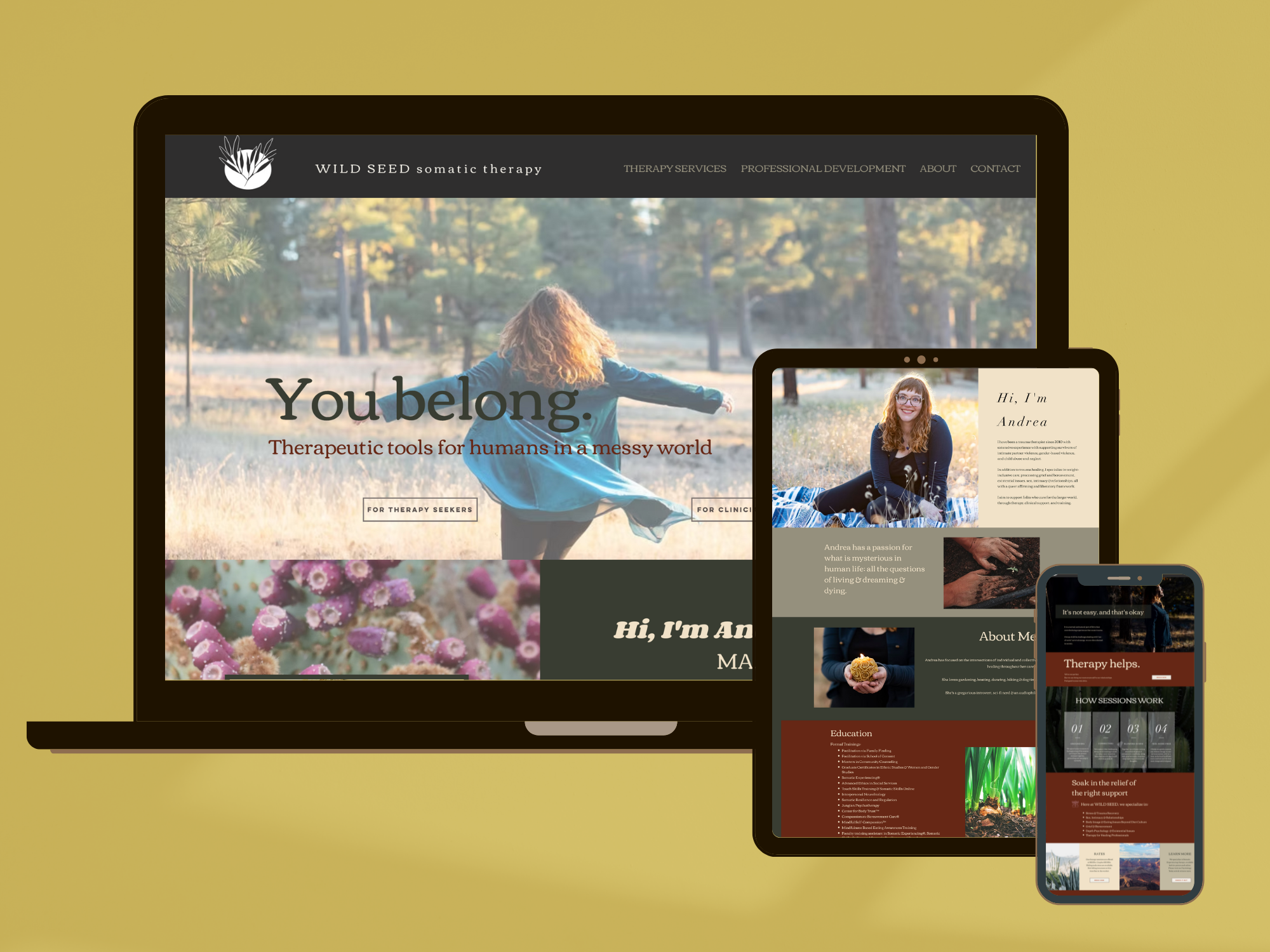
2. DIY Websites Often Create More Work (Not Less)
The promise of AI website builders sounds incredible.
"Just type a prompt and your website appears!"
In theory, this sounds like a dream.
In practice, it often looks more like this (and trust me, I know, because often clients come to me after they’ve tried this themselves):
1.) You generate some website copy.
2.) Then you tweak it.
3.) Then you tweak it again.
4.) You ask AI to make it sound warmer.
5.) Now it sounds overly fluffy.
6.) You ask it to make it sound more professional.
7.) Now it sounds stiff and robotic.
8.) Then you start actually trying to build the website itself and have absolutely no. freaking. clue. what you’re doing.
Suddenly you're deep in the weeds of:
fonts
color palettes
image sizing
layout decisions
SEO advice
booking integrations
mobile responsiveness
conflicting online tutorials
Hours turn into days.
Days turn into weeks.
And suddenly the website that was supposed to be “quick and easy” becomes a project hanging over your head.
Or just something ugly that doesn’t feel like you AT ALL.

Meanwhile, you’re still trying to run your business.
You’re seeing clients.
Writing session notes.
Answering emails.
Managing bookings.
Trying to maintain some semblance of work-life balance.
At a certain point many wellness practitioners realize something important:
Just because something is technically possible to DIY doesn’t mean it’s the best use of your time.
You trained for years to help people feel better in their bodies and lives.
Learning the intricacies of web design, branding strategy, SEO, and user experience probably wasn’t part of that training.
And it doesn’t have to be.
Working with a professional web designer allows you to focus on the work you actually love — while someone else handles the technical pieces that make your website function smoothly.

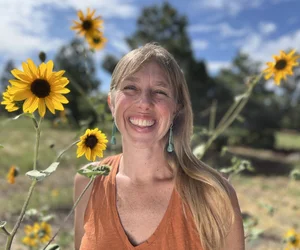
I’m Vanessa, web designer for wellness practitioners & Licensed Massage Therapist
3. The Right Questions Create the Right Website
One of the most valuable parts of working with a human web designer isn’t just the design itself.
It’s the questions we ask you along the way.
At Blue Skies Web Designs, every client receives thoughtfully crafted questionnaires designed to help clarify things many practitioners have never actually sat down to articulate.
These questionnaires guide you through questions like:
Who are your ideal clients?
Not just “people who want massage” or “people who need therapy.”
But the specific individuals who resonate most deeply with your work.
We explore things like:
What challenges are they experiencing?
What are the things in life they’re most passionate about?
What kind of language helps them feel comfortable reaching out?

We also look at your brand personality and visual style.
Your website should reflect your energy and approach, while also resonating with the audience you're trying to reach.
So we dig into things like:
the feeling you want your site to convey
colors and imagery that reflect your work
the aesthetic that will appeal most to your clients
the tone of voice that feels authentic to you
These questions help shape everything from the layout of your pages to the messaging on your homepage.
Because a website that tries to speak to everyone usually ends up connecting with… no one.
A thoughtful discovery process helps ensure your website actually attracts the right clients — the ones who feel aligned with your work and are excited to book.

4. AI Websites All Start to Sound the Same
AI tools rely on enormous datasets.
Which means the more people rely on them for website copy, the more websites begin to sound… exactly alike.
Snooze. Boooooring.
You’ve probably seen phrases like:
“Helping you step into your highest self”
“Supporting your healing journey”
“Empowering transformation”
None of these things are wrong.
But they’re also very generic.
And generic messaging makes it harder for potential clients to understand why they should work with you specifically.
Your website should reflect things like:
your personality
your training and experience
your cultural background
the modalities you practice
the types of clients you love supporting
A thoughtful web designer helps tease out those unique details so your website actually sounds like you, not like a collection of internet buzzwords.
Whether someone is searching for a massage therapist website, a therapist website design, or a holistic practitioner website, the most compelling sites are always the ones that feel genuine and personal.
This is why I ALSO provide all my clients with a “tagline writing recipe,” designed to help you eke out all the noise and refine exactly what you do in clear, concise words.
This is especially important for wellness practitioners, coaches, and therapists trying to stand out online.

5. Collaboration Creates Clarity
Something interesting happens when wellness practitioners collaborate with a designer.
Many start the process feeling unsure how to talk about their work.
They might say things like:
“I do a lot of different things.”
“It’s kind of hard to explain.”
“I hate talking about myself.”
Through conversation and collaboration (and some really great prompts), something begins to shift.
Ideas become organized.
Services become clearer.
Language becomes more natural and confident.
By the end of the process many practitioners say something like:
"I finally understand how to explain what I do."
And that clarity doesn’t just help your website.
It helps with:
consultation calls
networking conversations
social media posts
referrals from other practitioners
Your whole business becomes easier to communicate.
6. Technology Should Support Human Connection — Not Replace It
AI is an incredible tool.
It can help brainstorm ideas.
It can organize information.
It can even assist with small tasks.
But when it comes to the heart of your business — connecting with people who are seeking support — the human element still matters deeply.
Wellness work is built on:
trust
presence
authenticity
real human connection
Your website should reflect those same qualities.
Not feel like it was assembled by an algorithm.
The Real Question Isn’t “Can AI Build a Website?”
The answer to that question is increasingly:
Yes.
But the more important question is:
Will it build the right website for your work?
Will it communicate your values?
Will it attract the clients who resonate with your approach?
Will it make people feel comfortable enough to reach out?
For many wellness practitioners, the answer becomes clear after trying the DIY route.
They realize they don’t just need a website.
They need guidance.
They need someone who understands both:
the technical world of small business web design
and the relational world of wellness work
They need someone who can translate their passion and training into a website that feels welcoming, clear, and easy for potential clients to navigate.
In the End, Your Website Should Make Your Life Easier
Running a wellness practice already requires you to juggle a lot (believe me, I know, after doing ALL THE THINGS for ten years)!
Your website shouldn’t be another source of stress.
A well-designed website should:
welcome your ideal clients
answer common questions
clearly communicate your services
make scheduling easy
support the growth of your business
In other words…
A good website should make your life — and your work — easier.
And if building one has been sitting on your to-do list for months (or even years)…
You don’t have to figure it out alone.
Working with a thoughtful web designer — whether you’re in Flagstaff, elsewhere in Arizona, or anywhere in the U.S. or world — can transform what feels like an overwhelming tech project into a collaborative process that brings clarity to your work and helps your ideal clients find you.
Because if you're in the human business…
you should probably work with humans. :)

Vanessa Rae, Squarespace web designer & recovering LMT
Curious What Working Together Might Look Like?
If you’re a wellness practitioner, therapist, bodyworker, or small business owner who’s been feeling overwhelmed by the idea of building your website, you’re not alone.
Many of my clients come to me after spending weeks (or months!) trying to DIY their site before realizing they’d rather focus their time and energy on the work they actually love.
At Blue Skies Web Designs, I specialize in thoughtful, collaborative website design for wellness practitioners and small businesses — with an emphasis on clarity, warmth, and creating a site that truly reflects you.
If you’re curious about what it might look like to work together, you can learn more about my web design services here:
There you’ll find details about my process, what’s included in a website project, and how I help bring your work to life online.
And if it feels like a good fit, I’d love to connect.